
Hidden is the kind of crime drama that quietly pulls you into its world and then makes it remarkably difficult to leave.
I know this because I watched all three seasons in one weekend.
Not because every episode ends with some enormous manufactured cliffhanger, and not because the series is constantly throwing another body at us. It is much more controlled than that. Hidden draws you in through people, damaged communities, uncomfortable families and a North Welsh landscape that seems to carry the weight of everything that has happened there.
By the time I reached the third season, I did not feel as though I had watched three separate crime stories.
I felt as though I had spent a weekend in Cadi John’s Wales.
And it is not always an easy place to be.
The Crime Is Only the Beginning
The first season begins when the body of a young woman, missing for years, is discovered in a river. DCI Cadi John and DS Owen Vaughan investigate, but Hidden makes an interesting decision very early on: it is not particularly interested in playing a traditional game of guess the killer with us.
We are allowed to see darkness from several directions.
The real question becomes less about who and much more about why.
That approach continues through the series. In the second season, the death of a former teacher leads us into the lives of three teenagers in Blaenau Ffestiniog. By the third, another body has been found and another damaged collection of relationships begins to unravel.
Different crimes.
Different families.
Different forms of damage.
But the same feeling runs underneath all three seasons: violence rarely arrives from nowhere.
There is almost always something underneath it.
Neglect. Resentment. Poverty. Abuse. Isolation. Family history. People who have been failed and people who then go on to fail somebody else.
Hidden is interested in what happens before the crime as much as what happens afterwards.
And that makes it far more unsettling.
Cadi John Doesn’t Need to Perform Being a Detective
Sian Reese-Williams gives us something I increasingly appreciate in crime drama: a female detective who does not need a collection of exaggerated characteristics to prove that she is interesting.
Cadi John is intelligent, persistent and emotionally complicated, but she is not presented as some impossible investigative genius.
She listens.
She watches.
She keeps going.
And she is tired sometimes.
Her work does not exist in a separate television universe where detectives solve murders and then switch themselves off when they go home. Her father is ill when we first meet her. Her sisters have their own lives. The family house carries memories. Relationships move and change while the investigations continue.
Her personal life is present without swallowing the crime story.
That balance matters.
There has been a tendency in television to believe that a female detective must either be extraordinarily damaged or extraordinarily brilliant in order to justify being at the centre of a crime series.
Cadi doesn’t need either trick.
She is simply very good at what she does.
And over three seasons, that becomes enough.
And Then There Is Owen
DS Owen Vaughan could easily have been written as nothing more than Cadi’s police partner.
Instead, he becomes one of the quiet strengths of the series.
There is an ease between Cadi and Owen that I particularly liked because Hidden never seems desperate to force their relationship into something it doesn’t need to become.
They work together.
They understand each other’s rhythms.
They disagree.
They continue.
Owen also has a life beyond the police station, and as the seasons pass we see his responsibilities change. Again, Hidden does not turn this into a separate soap opera running beside the murder investigation. It simply reminds us that these detectives are ordinary people who happen to spend their working lives walking into extraordinary situations.
That normality gives the series credibility.
North Wales Is Not Here to Look Pretty
And then we come to the reason Hidden belongs so naturally on Mapped in Drama.
North Wales.
This is not postcard Wales.
Of course the mountains are beautiful. The Menai Strait is beautiful. The enormous views across Eryri are beautiful.
But Hidden isn’t particularly interested in selling us the beauty.
It shows us the isolation that comes with it.
A house almost cut off by the tide.
Long roads through mountains.
Old industrial towns.
Slate.
Water.
Quarries.
Housing estates.
Remote buildings.
Places where the distance between two houses can suddenly feel very important.
The series was filmed across North Wales, with Bangor and the Menai Strait particularly visible in the first season and Blaenau Ffestiniog becoming central to the second. Cadi’s extraordinary home sits on Ynys Castell in the Menai Strait, separated from the mainland according to the tide.
It is one of those rare television houses that tells you something about the person living inside it before anyone says a word.
Beautiful.
Private.
Exposed.
And occasionally cut off from everyone else.
You could hardly choose a better home for Cadi John.
Blaenau Ffestiniog Changes the Texture
I particularly liked the shift in the second season.
Moving much of the story into Blaenau Ffestiniog changes the visual language of the series. The slate quarries, mountains and old industrial landscape give the crime a different texture.
This isn’t rural Wales presented as an untouched paradise.
People live here.
Young people grow up here.
Families struggle here.
People become bored here.
People get angry.
And some want desperately to leave.
That is important because beautiful landscapes on television can sometimes become strangely empty. We admire them while forgetting that they contain actual communities.
Hidden doesn’t allow that.
Its Wales is inhabited.
And sometimes those communities are struggling.
The Young People Are Not Just Plot Devices
This becomes particularly important in the second season.
Teenagers in crime dramas are often written from the adult perspective: troublesome, secretive, aggressive, incomprehensible.
Hidden gives them space.
Mia, Connor and Lee are allowed to be uncomfortable characters. Sometimes deeply uncomfortable.
But the series also looks at the homes they come from, the adults around them and the environments that have shaped them.
It doesn’t excuse everything.
It tries to understand it.
There is a difference.
And I think that is one of the things Hidden does best throughout all three seasons.
It repeatedly asks us to look beyond the criminal act and towards the chain of events that made it possible.
That can make the series harder to watch than a straightforward murder mystery.
Finding a killer gives us an ending.
Understanding how somebody became capable of doing terrible things is much less comforting.
Craith — The Welsh Identity Matters
There is another part of Hidden that should not disappear when we talk about the series internationally.
It is Welsh.
Not just filmed in Wales.
Welsh.
The series was originally broadcast on S4C as Craith and was produced in Welsh and English/bilingual versions.
That matters.
Hearing Welsh spoken inside Welsh homes and communities gives the place another layer of identity. It reminds us that this landscape does not simply belong to the generic category of “beautiful British countryside.”
There is a language here.
There is a culture here.
There is a specific place here.
Crime drama travels incredibly well across Europe precisely when it refuses to flatten those differences.
The more local a series is prepared to be, strangely enough, the more interesting it can become to the rest of us.
Three Seasons Were Enough
There is something else I respect enormously about Hidden.
It ended.
Three seasons.
Three investigations.
A journey for Cadi John.
And then it stopped.
The third season was deliberately announced as the final series.
There is a confidence in allowing a programme to finish while we still care about it.
Not every successful detective needs twelve seasons.
Not every character needs to be followed until every possible piece of mystery has disappeared.
Sometimes it is better to leave them while their world still feels larger than what we have been shown.
After spending an entire weekend with Cadi, Owen, the mountains, the quarries, the rivers and those long North Welsh roads, I certainly could have watched more.
But I am not sure I needed more.
And perhaps that is the difference.
Wales Knows How to Do Darkness
Having watched Under Salt Marsh and then finding myself disappearing into all three seasons of Hidden, I am beginning to think Wales deserves its own conversation within British crime drama.
Not because Welsh crime television needs to imitate anyone else.
Quite the opposite.
There is something very particular happening here.
The mountains can be enormous without becoming romantic.
The villages can be small without becoming quaint.
The language remains present.
The communities are complicated.
And the beauty of the landscape is allowed to coexist with poverty, violence, grief, boredom and isolation.
Hidden never needs to shout about any of it.
It simply puts Cadi John in a car, sends her along another road through North Wales and allows the landscape to tell us where we are.
Three seasons in one weekend.
That probably tells you everything you need to know about whether it kept me watching.
WATCH THE TRAILER BELOW
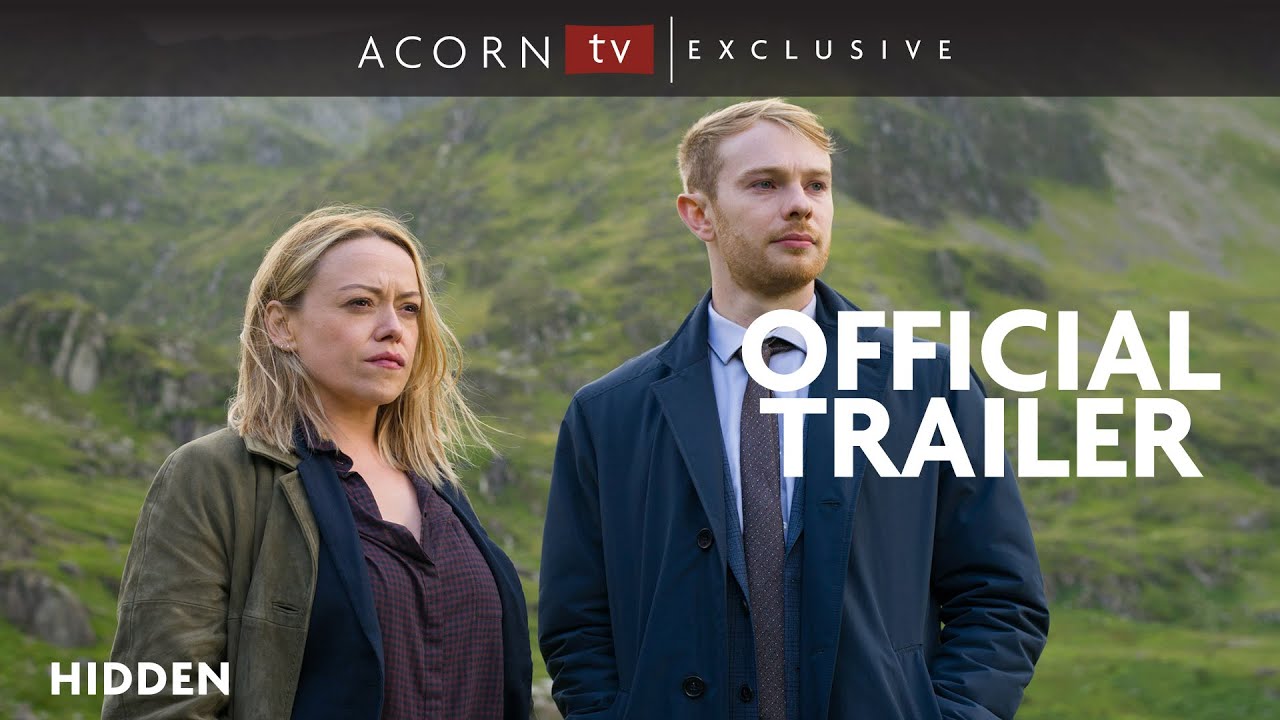
The gripping drama can be watched on Acorn TV Exclusive.