
Under Salt Marsh begins with the kind of discovery that needs very little embellishment: a young boy is found dead in the marshes by his teacher, and a small Welsh community suddenly has nowhere left to hide.
It is a simple beginning, but simplicity can be deceptive. The fictional town of Morfa Halen is already carrying the weight of an older disappearance, and as the investigation into nine-year-old Cefin’s death begins, past and present start moving towards each other. Add an approaching storm, rising water and a landscape capable of swallowing evidence almost as quickly as people can uncover it, and the result is a crime drama that understands atmosphere from its opening moments. The series runs for six episodes, exactly the kind of contained format that allows a story like this to remain tight without becoming rushed.
There are elements here that will feel immediately familiar to anyone who loves Nordic noir. The isolation. The weather. The uncomfortable silences. A community where everybody seems to know everybody else, yet nobody appears to know quite enough. And, of course, the landscape.
The Nordics have mastered the art of making us stare at snow, forests and grey skies until we begin to suspect the scenery itself. Here, it is the marsh.
Water, mud, mountains, sea walls and enormous stretches of open land surround the characters. North Wales does not sit politely behind the story waiting to look beautiful. It interferes. It threatens. It restricts movement. A storm is coming, the water is rising, and suddenly nature has its own deadline for the investigation. Sky itself describes Wales as an essential presence in the drama, with locations along the North Wales coast inspiring Morfa Halen.
And then there is Kelly Reilly.
I have been watching her grow through her work for years, and there is something incredibly satisfying about seeing where she has arrived.
For so many viewers now, Kelly Reilly is Beth Dutton.
Watching Yellowstone, it is remarkably easy to forget that the woman delivering those lines with that American accent is an English actress. Beth is explosive, difficult, wounded, intelligent, sometimes terrifying and impossible to ignore. Reilly inhabits her so completely that the accent eventually becomes almost irrelevant — it simply belongs to Beth.
And then you change channel.
There she is again.
Except Beth has disappeared.
In Under Salt Marsh, Reilly is Jackie Ellis, a primary-school teacher and former detective whose life has already been shaped by loss long before she discovers Cefin. Suddenly we are back in Britain, hearing her in a voice much closer to home, watching an entirely different kind of woman occupy the screen.
That transformation is such a pleasure to watch.
There is no need for Jackie to carry Beth Dutton’s armour into Wales. Reilly does not simply change her accent and costume and expect us to believe we are looking at someone else. Her whole presence changes. Jackie is quieter, more contained, but underneath that restraint is somebody who notices things and cannot easily leave questions unanswered.
Rafe Spall, as Detective Eric Bull, gives the story another necessary layer. Jackie and Bull have history, both professional and personal, and his return to investigate Cefin’s death forces Jackie back towards a world she had tried to leave behind. Their relationship gives the investigation weight because this is never simply police arriving in an anonymous town to solve a case. Everyone involved is carrying something into it.
And this is where British crime television often gets things very right.
The Nordics are extraordinarily good at atmosphere.
The British are extraordinarily good at packing the essentials into a story.
Six episodes.
A child is dead.
Another child disappeared before him.
A former detective who thought she had walked away from that life finds herself standing in the middle of another investigation.
An old colleague returns.
A community closes ranks.
A storm approaches.
That is enough.
We do not need twelve episodes of increasingly unlikely subplots. We do not need another murder every forty minutes simply to persuade us to keep watching. We do not need a new villain introduced every time the story begins to breathe.
Instead, Under Salt Marsh allows suspicion to grow out of people, relationships and place.
That six-episode British format has become one of crime television’s greatest strengths. When it works, there is little room for waste. Characters have to matter. Conversations have to take us somewhere. A look across a kitchen table can carry information that another series might spend an entire episode explaining.
And yet the story still has room to breathe.
That is the interesting contradiction.
The drama is economical without feeling small.
Perhaps that is because the marshes give it space. The camera can leave the houses and police rooms behind and suddenly we are looking across an enormous stretch of Welsh landscape where a person can appear very small indeed. The physical world expands while the investigation becomes increasingly claustrophobic.
It is one of my favourite combinations in European crime drama: a small community inside a huge landscape.
There is nowhere to go, yet there is an enormous amount of space in which things can disappear.
Under Salt Marsh understands that perfectly.
It also understands something else that the best crime dramas know: the death at the centre of the story may start the investigation, but it is the people left behind who make us continue watching.
And for me, there is the additional pleasure of watching Kelly Reilly at this point in her career. From Britain to America and back again, from Beth Dutton to Jackie Ellis, she has reached that wonderful stage where I am no longer particularly interested in seeing what she will “do” with a role.
I simply want to see who she becomes next.
For now, though, I am very happy to follow her into the marsh.
WATCH THE TRAILER BELOW
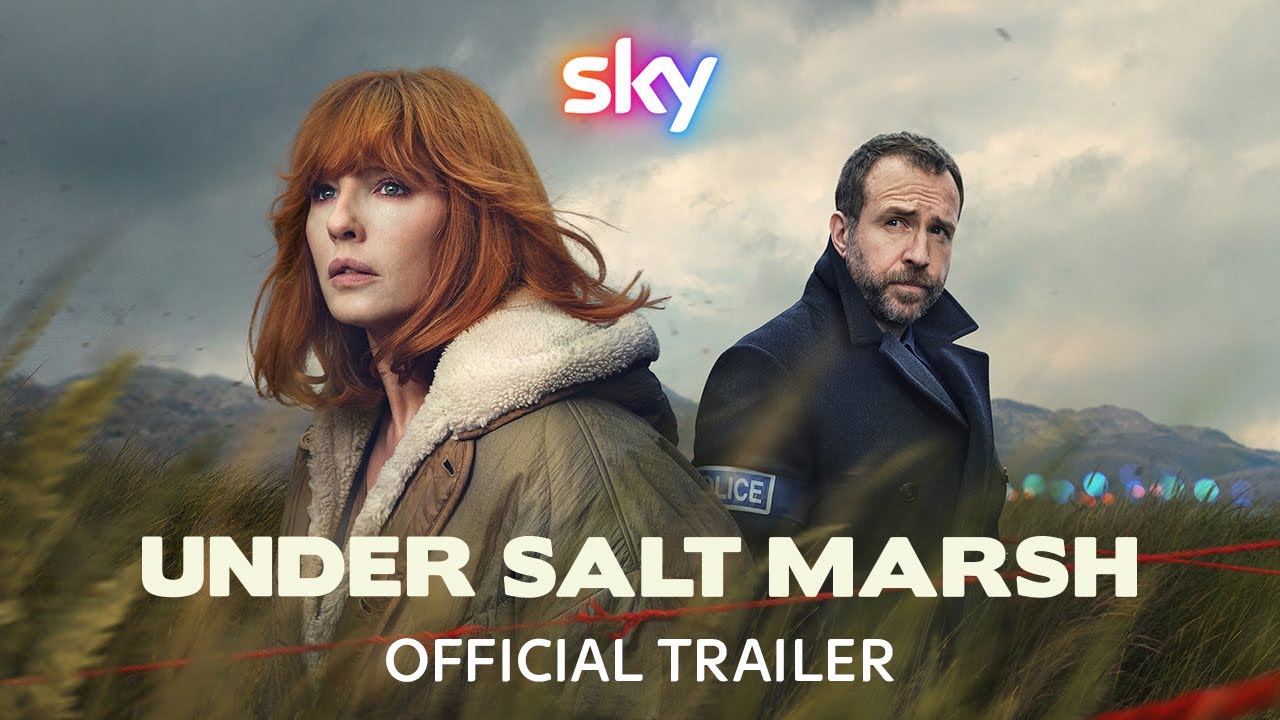
You can watch the crime thriller miniseries Under Salt Marsh streaming exclusively on Sky Atlantic, Sky Go, and NOW in the United Kingdom.