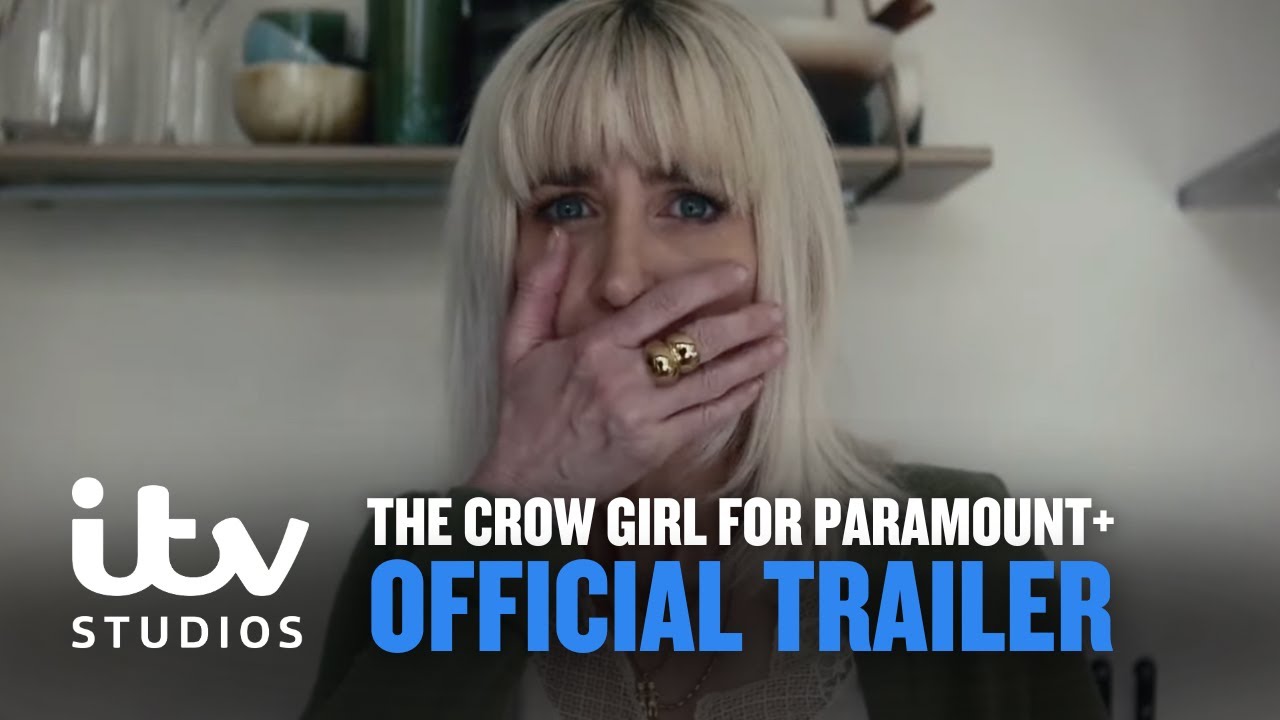
Every so often a crime drama comes along that makes “just one more episode” completely impossible to resist.
The Crow Girl is one of those.
Dark, unsettling and psychologically complicated, it begins with the discovery of the body of a teenage boy and very quickly makes it clear that this is not going to be a conventional hunt for a killer.
There are murders here. But underneath them are older wounds.
Abuse. Silence. Trauma. Children who were not protected. Adults who looked away. Institutions that failed. And the frightening possibility that what is happening now may have begun many years earlier.
It is an extraordinarily gripping story.
And perhaps the most interesting thing about The Crow Girl is that although we are watching a British crime drama set in Bristol, somewhere underneath it all you can still feel Scandinavia.
From Sweden to Bristol
The Crow Girl is adapted from the bestselling Swedish crime novels written under the name Erik Axl Sund, the pseudonym used by writers Jerker Eriksson and Håkan Axlander Sundquist.
For television, writer Milly Thomas has moved the story from Sweden to Bristol. The first series was filmed entirely in and around the city and stars Eve Myles as DCI Jeanette Kilburn and Katherine Kelly as psychotherapist Dr Sophia Craven.
Moving Scandinavian crime fiction to Britain could easily have destroyed what made the original material distinctive.
Surprisingly, it hasn’t. Instead, Bristol has been made to feel almost Nordic.
Winter light. Grey skies. Wet streets. Concrete. Empty spaces.
A sense that darkness is sitting just beyond the edge of the frame.
This is certainly not tourism-board Bristol.
And I love that.
Bristol Is Allowed to Become Somewhere Else
One of the things we talk about repeatedly on Mapped in Drama is the difference between using a location and simply showing it.
The Crow Girl uses Bristol.
Castle Park, Queen Square, Princes Wharf, Wine Street and other parts of the city appear throughout the series, while the production transformed the Old Bank of England building on Wine Street into the headquarters of the fictional Bristol Metropolitan Police.
But there is no desperate attempt to make the city attractive.
Quite the opposite.
The production takes a lively, colourful British city and drains away much of its warmth.
It creates a place where something terrible could have happened twenty years ago and somehow still be moving silently underneath the present.
That Scandinavian inheritance is difficult to miss.
This isn’t Sweden.
But occasionally it feels like Sweden.
Jeanette Kilburn and Sophia Craven
Then we have the two women at the centre of the story.
And this is where The Crow Girl becomes far more interesting than another serial-killer drama.
DCI Jeanette Kilburn is the investigator.
Dr Sophia Craven is the psychotherapist.
One searches for evidence.
The other searches through memory.
Jeanette wants to understand what happened.
Sophia wants to understand why.
Eve Myles and Katherine Kelly are both excellent, but more importantly, neither woman has been written simply to support the other’s story.
These are two substantial female characters with careers, flaws, desires, private histories and complicated moral boundaries.
Their relationship gradually becomes as important as the investigation itself.
The production describes what develops between them as a “complex, twisted love story”, while the investigation pulls both women deeper into a history of abuse, disappearances and murder.
And “complex” is definitely the word.
There is attraction.
Trust.
Suspicion.
Professional dependence.
Emotional dependence.
And the uncomfortable awareness that neither woman completely understands the other.
Exactly the kind of relationship crime drama needs more of.
The Story Doesn’t Let You Feel Comfortable
What makes The Crow Girl so gripping is not simply that it keeps giving us questions.
It keeps changing the meaning of the questions.
You think you understand somebody.
Then another piece appears.
You think you have worked out what happened.
Then the story quietly moves something underneath you.
And because psychology sits at the centre of the investigation, memory itself becomes unstable territory.
What does a traumatised child remember?
What does an adult choose not to remember?
What happens when survival requires a person to separate themselves from something unbearable?
And perhaps most disturbingly:
What happens when the adults who were supposed to protect a child simply don’t?
There are scenes in The Crow Girl where what isn’t shown becomes more disturbing than anything the camera could show us.
A door closing. Someone leaving. A frightened look.
A sentence whose meaning becomes clear only a few seconds later.
The series understands that sometimes implication is more powerful than spectacle.
The Real Horror Is Not the Killer
That is perhaps what I find most effective about the series.
The murderer is frightening.
But the murderer isn’t necessarily the most frightening thing here.
The real horror is the network of silence that allows abuse to continue.
A child can tell someone.
An adult can notice something.
A police officer can ask questions.
A parent can suspect.
An institution can receive a warning.
And still nothing happens.
That idea is much harder to shake off than another television serial killer standing dramatically in a dark room.
Because The Crow Girl keeps returning to something painfully believable: Evil does not always survive because nobody knows about it.
Sometimes it survives because people know enough — and still do nothing.
Trauma Is Not Used Merely as Decoration
Crime drama has an uncomfortable history with childhood trauma.
Too often it becomes an easy explanation.
Character behaves strangely?
Childhood trauma.
Character becomes violent?
Childhood trauma.
Mystery solved.
The Crow Girl tries to do something considerably more complicated.
Trauma doesn’t sit neatly in the past.
It changes relationships.
Memory. Sexuality. Trust. Identity. The ability to recognise danger.
Even the ability to understand yourself.
And because Sophia is a psychotherapist, the series can approach those questions from somewhere other than the police interview room.
That gives the story another dimension.
The investigation is not simply asking: Who did this?
It is also asking: What did this do to the people who survived it?
Those are very different questions.
Women Are Not Standing Beside the Investigation
There is something else worth noticing.
Once again, we have women occupying the cerebral centre of a crime story.
Jeanette isn’t someone’s junior detective waiting to be taught how policing works.
Sophia isn’t the female psychologist brought in for one episode to explain the killer.
They drive the story.
They interpret it.
They disagree.
They make mistakes.
They challenge one another.
They carry authority.
And they are allowed to be emotionally complicated without that complexity making them professionally incompetent.
That distinction matters.
For years, television gave male investigators enormous freedom to be obsessive, traumatised, alcoholic, sexually chaotic, socially impossible and frequently terrible husbands — while still presenting them as brilliant detectives.
Women deserve the same narrative freedom.
Jeanette and Sophia are allowed to be interesting before they are likeable.
Good.
And Then There Is Eve Myles
Eve Myles is particularly good here.
Jeanette could have become another permanently miserable detective walking through grey corridors.
Instead, Myles finds warmth in her.
There is humour.
Impatience.
Vulnerability.
A little defiance.
And the sense of a woman desperately trying to remain functional while the investigation becomes increasingly difficult to separate from her personal life.
Katherine Kelly’s Sophia operates at almost the opposite temperature.
More controlled.
More difficult to read.
A person professionally trained to understand what others reveal while being considerably less willing to reveal herself.
Put those two performances together and the series develops an emotional tension that exists even when very little is being said.
Scandi Noir Never Really Left Sweden
And this may be the part of The Crow Girl that interests me most.
We’ve talked before on Mapped in Drama about what Nordic noir actually changed.
It wasn’t simply snow.
Or knitwear.
Or desaturated colour palettes.
The important inheritance was deeper.
Crime became a way of examining society.
The murder was the door.
Behind it were institutions, inequality, family, gender, politics, corruption, violence and the things respectable societies preferred not to discuss.
That influence travelled.
And The Crow Girl demonstrates just how far.
Here we have a British production, filmed in Bristol, adapted from Swedish novels, carrying the psychological darkness and social unease of Scandinavian crime fiction into a recognisably British world.
It isn’t pretending to be Nordic noir.
It doesn’t need to.
Nordic noir has simply become part of crime television’s language.
Darkness Without Gloss
There is another reason this one belongs here.
It doesn’t look glossy.
Thank goodness.
Nobody seems worried about making Bristol aspirational.
The police station isn’t an architectural showroom.
Homes look inhabited.
Streets look wet.
People look tired.
The darkness isn’t beautified simply because somebody thought crime television needed to look expensive.
There is visual control here, certainly.
But there is still texture.
Place.
Weather.
Human faces.
It feels like somewhere.
And that remains one of the things I value most in European and British drama.
Give me somewhere real over somewhere perfect.
Every time.
The Title Becomes More Disturbing the Longer You Watch
And then there is the title.
The Crow Girl.
At first it sounds like exactly what a crime thriller title is supposed to sound like.
Dark.
Mysterious.
Slightly gothic.
Keep watching.
The crow begins to carry far more weight.
Identity.
Memory.
Childhood.
Protection.
Transformation.
The person somebody was.
The person they became in order to survive.
I won’t say any more because The Crow Girl is one of those rare series where being told too much genuinely damages the experience.
Go into it knowing as little as possible.
And pay attention.
To names.
To memories.
To photographs.
To the things people say.
And particularly to the things they don’t.
A Story That Gets Under Your Skin
Some crime dramas are extremely enjoyable while you are watching them and surprisingly easy to forget afterwards.
I don’t think The Crow Girl is going to be one of them.
It is too uncomfortable.
Too psychologically tangled.
And, frankly, too gripping.
The murders pull us into the story.
But they are not what keeps us there.
It is the people.
Jeanette.
Sophia.
Victoria.
The children nobody protected.
The adults carrying versions of themselves they thought they had buried.
And the increasingly disturbing realisation that solving the crime and understanding what happened may not be the same thing at all.
The Crow Girl may have travelled from Swedish fiction to Bristol television.
But it has carried the darkness with it.
And this time, the darkness isn’t coming from the weather.
It is coming from memory.
Personal Note: Could Feel the Difference in My Bones
There was something about The Crow Girl that felt different almost immediately.
And I simply mean that I didn’t knew the story originated in Sweden.
I could feel there was something diffrent..
There was a Northern air running through it that Bristol could not disguise — and perhaps was never supposed to.
It wasn’t about snow, Scandinavian architecture or the familiar visual shorthand of Nordic noir. It was something much less obvious.
The psychology.
The silences.
The way trauma sits underneath ordinary conversation.
The uncomfortable pauses where another drama might have given us an explanation.
The sense that people are carrying whole histories inside them while revealing almost nothing.
I could feel the difference in my bones.
This might physically be a British crime drama, but emotionally it belongs somewhere further north.
And perhaps that is what decades of Nordic noir have taught us to recognise. It isn’t really a colour palette. It is a way of looking at human behaviour.
Crime becomes psychology.
The investigation becomes an excavation.
And what happened twenty years ago can feel every bit as present as the body lying in front of the detective today.
WATCH THE TRAILER BELOW