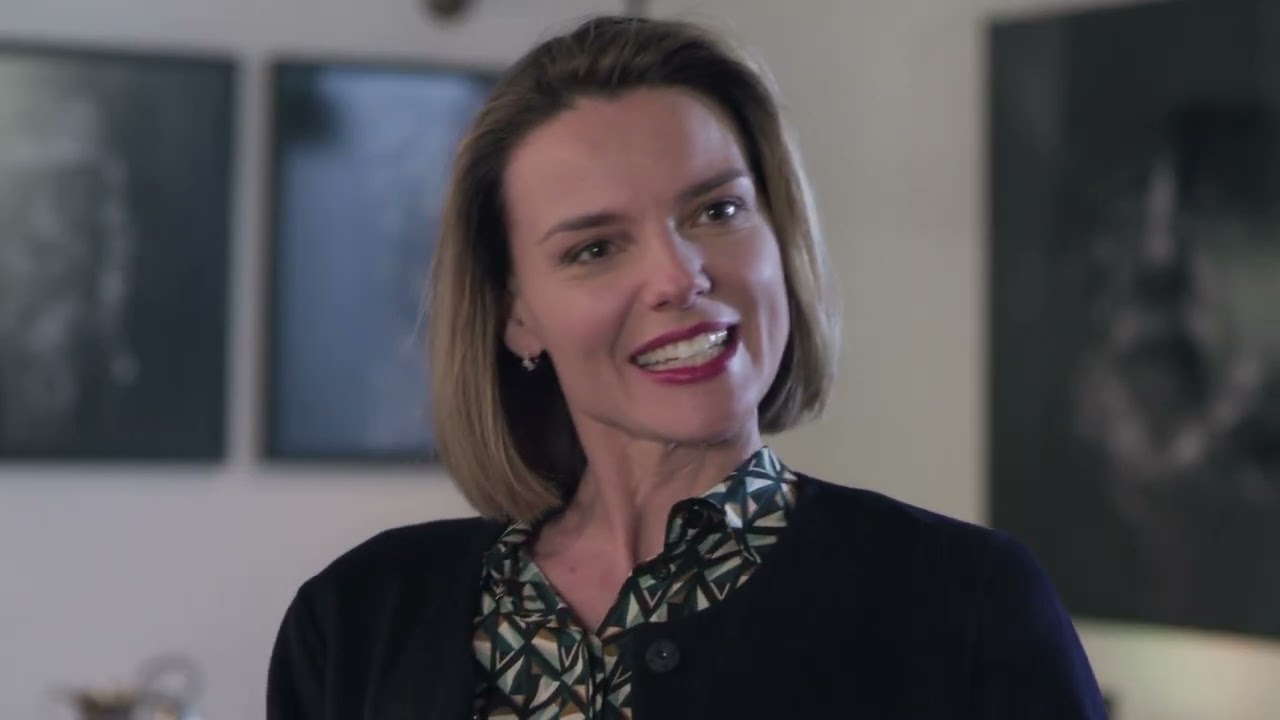
There are cities that behave politely in a TV series.
They give you a nice view, a few pretty streets, a church, a balcony, maybe a coffee cup in the sun.
Naples is not that kind of city.
In Mina Settembre, Naples is not background. It is noise, crime, family, pressure, gossip, sea, religion, food, heat, neighbours, arguments, mothers, children, old wounds and people who know too much about your business.
And Mina belongs to that world completely.
She is not a detective walking through the city like an outsider. She is not a tourist. She is not discovering Naples for us. She is already inside it. She knows its moods. She knows when people are lying, when they are ashamed, when they are trying to survive, and when they just need someone to sit opposite them and listen.
That is why Naples works so well for her character.
Mina is a social worker, so the city comes to her through people. Not through monuments. Not through postcard shots. Through women in trouble, children who need protection, families falling apart, men who disappear, mothers who cannot cope, old secrets sitting inside kitchens and corridors.
And Naples is perfect for that because it feels like a city where private life is never fully private. Someone is always watching from a balcony. Someone has heard something. Someone has an opinion. Someone brings food. Someone interferes. Someone saves you and annoys you at the same time.
That is very Mina too.
She is warm, but she is not soft in a useless way. She gets involved. She pushes. She asks questions. She makes mistakes. She carries other people’s pain even when her own life is already a mess. And the city around her feels the same: beautiful, generous, chaotic, impossible, alive.
The Rione Sanità gives the series a very specific heart. It is not the polished Naples of the seafront only. It is a Naples of courtyards, staircases, old buildings, voices, narrow streets and history sitting on top of ordinary life. It has beauty, but not the clean kind. It has the kind of beauty that looks lived in, damaged, repaired, used again.
That is what I like about Mina’s Naples. It does not pretend that life is simple.
There is the sea, yes. There is light. There is food. There is the drama of Vesuvius sitting in the distance like a reminder that nothing here is ever completely calm. But there is also poverty, pressure, emotional mess, survival mode, social work, family duty and the kind of pain that does not disappear just because the city is beautiful.
And food matters too, because Naples is not a city where people just eat. Food is language. A folded pizza eaten quickly, a coffee, something fried in paper, something sweet, something given to you when words are not enough. In Mina’s world, food feels like part of the emotional system of the city. People feed you, judge you, comfort you, and then tell you exactly what you are doing wrong.
Mina herself feels like Naples in human form sometimes.
Colourful. Emotional. Tired. Funny. Too involved. Full of contradictions. Capable of making a disaster and then somehow making you forgive her.
And maybe that is why the series stays with me. Not because it shows Naples as perfect, but because it shows Naples as a place where life keeps happening loudly. People fall apart, but the city does not stop. Someone is shouting, someone is cooking, someone is crying, someone is walking to work, someone is trying again.
Mina Settembre is not just set in Naples.
It breathes Naples.
And Naples, like Mina, does not let you stay distant for very long.
Personal Note:
Mina Settembre is perhaps the exception in Mapped in Drama. Strictly speaking, this is not a crime drama. Mina is a social worker, not a detective, and the series is much more interested in families, poverty, relationships and the everyday problems of Naples than in solving murders. But her work constantly places her close to the consequences of crime, vulnerability and social injustice, and that is exactly why I want to keep her here. Crime drama has never interested me only because of the crime itself; I am interested in what a series tells us about the society surrounding it. Mina moves through Naples meeting people who might otherwise remain invisible, entering homes and neighbourhoods that a traditional police investigation would approach very differently. In many ways she takes us even deeper into the city than a detective could. So yes, Mina Settembre may sit slightly outside the usual boundaries of this blog — but the place, the people and the social realities behind the stories make her feel completely at home here.
WATCH MINA SETTEMBRE SEASON 1 TRAILER BELOW