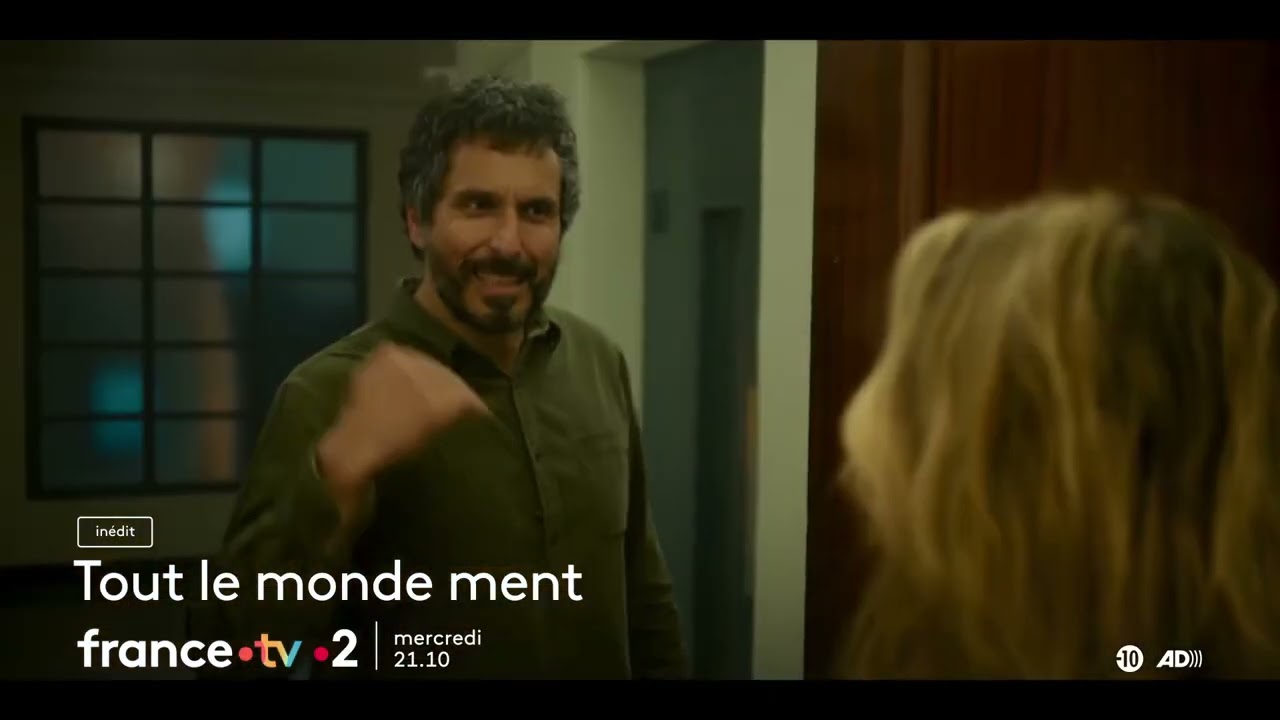
There are crime dramas built around the question who did it? And then there are those that are much more interested in asking another question:
What happens when everybody knows who is doing wrong, but the person responsible is simply too powerful to touch?
Tout le monde ment — brought to British audiences by Walter Presents under the title Everybody Lies — belongs firmly to the second group.
At its centre is Vincent Verner, played by Vincent Elbaz, a former police officer whose career ended because he refused to do the one thing that might have saved it: look the other way.
Now working away from the police, he is approached by young prosecutor Alice Mojodi and drawn into the Groupe des Affaires sensibles, a fictional unit created to investigate precisely the people conventional systems struggle to reach — powerful figures from business, politics, finance, media and celebrity.
And suddenly the title becomes much more interesting.
Because everybody may lie. Vincent Verner doesn’t.
The Investigator Who Cannot Play the Game
Crime television has given us plenty of difficult detectives.
They drink too much. They ignore authority. They destroy relationships. They obsess over cases. They sleep in their offices and somehow remain employed despite behaving in ways that would get most people escorted from the building.
Verner is different. His problem is truth.
He seems almost physically incapable of accepting the little compromises that allow institutions to function. He does not understand why someone’s position should determine how carefully they are investigated. He does not accept that wealth, celebrity or political connections should create a different version of justice.
That refusal has already cost him his police career.
And yet it is precisely why Alice wants him.
France Télévisions describes him as a policeman dismissed after pursuing the truth in an investigation too far, and as the principal asset of the Sensitive Cases team.
There is something enormously satisfying about watching a character whose greatest professional weakness turns out to be exactly what the job requires.
A Different Kind of Police Team
The team surrounding Verner is equally important.
Alice Mojodi, played by Mariama Gueye, is the young prosecutor leading the unit. Malory Servaz, played by Joséphine de Meaux, brings another energy entirely, while Julien de Grève, played by Thomas Silberstein, completes a group that feels deliberately assembled from people who do not fit neatly into the usual police-drama hierarchy.
They are not presented as the polished elite of French law enforcement. Perhaps that is the point.
If you want to catch people who have spent their lives learning how the system works, sometimes you need investigators willing to stop behaving according to the system’s expectations.
The fictional Sensitive Cases Unit has one purpose: going after people who have become almost untouchable.
Businessmen. Celebrities. Political figures.
People surrounded by lawyers, influence, money and friends in useful places.
Creator and screenwriter Olivier Norek has said that this fictional brigade grew from the idea that certain powerful sections of society can appear to escape consequences because of their position and their ability to protect one another.
That makes Tout le monde ment considerably more interesting than a simple procedural.
The crime may begin the story.
Power is really what is being investigated.
Olivier Norek Knows This World
There is another reason the series feels grounded.
Olivier Norek did not approach policing purely from a writer’s imagination. Before becoming known as a crime novelist and screenwriter, he spent years working in the French police.
That background matters.
Because underneath the humour and the unconventional team lies a serious question about justice: does the law work equally well when the suspect has influence?
The first investigation sends the team after a powerful businessman.
Another story turns toward a famous actor and allegations of sexual violence, deliberately touching on questions brought to the surface by #MeToo. Later investigations return to corporate power and the consequences of people who have remained protected for years.
These are not stories about anonymous criminals hiding in dark streets.
They are about people standing comfortably in the light because they have learned that nobody is likely to challenge them.
And Verner exists to challenge them.
Paris Without the Postcard
Then there is Paris.
For Mapped in Drama, location is never simply decoration, and Tout le monde ment gives us a version of the city that works particularly well for this story.
Verner’s world includes a second-hand bookshop in the Latin Quarter — a wonderfully appropriate refuge for a man apparently more comfortable with books and truth than social diplomacy.
Scenes connected with the fictional bookshop were filmed at Librairie Rieffel, 15 rue de l’Odéon, in Paris’s 6th arrondissement. Other filming also took place outside Paris, including Lyon.
This is the Paris I enjoy seeing on television.
Not simply the Eiffel Tower arriving every few minutes to remind international viewers which country they are in.
Streets. Bookshops. Apartments. Offices. Cafés. People actually living in the city.
A Paris that is allowed to function as somebody’s home rather than somebody else’s holiday.
Humour Where You Don’t Expect It
Despite the subject matter, Tout le monde ment does not bury itself completely in darkness.
There is humour here.
There is friction between the characters, awkwardness, impatience and a kind of reluctant affection. France Télévisions itself described the second instalment as moving between darkness and humour.
That balance is important.
European crime drama does not always have to choose between brutal Nordic darkness and cosy crime. There is a very large territory between the two, and French television has become particularly good at occupying it.
The crimes can be serious.
The social questions can be uncomfortable.
And the characters can still be funny.
Human beings generally are.
And Please — Watch It in French
This is Walter Presents, so I am going to repeat something I seem to write increasingly often on Mapped in Drama:
Watch it in the original language.
Vincent Elbaz’s Verner is built partly through rhythm — the impatience, the clipped exchanges, the sudden changes in tone and the way irritation sounds when it comes naturally rather than through another actor’s dubbing performance.
French has its own speed, aggression, humour and musicality.
Remove the voice and you remove part of the character.
Subtitles require a little more attention.
That is not a disadvantage.
Sometimes television deserves our attention.
Why Walter Presents Still Matters
And perhaps this series arrives at exactly the right moment for another reason.
Tout le monde ment is now available to UK viewers through Walter Presents and Channel 4 streaming, where it launched in August 2026.
Without services willing to look beyond English-language television, how many viewers here would ever have met Vincent Verner?
Or Astrid Nielsen?
Or Andri Ólafsson?
Or dozens of the characters who have slowly built the map of this website?
Walter Presents does something deceptively important.
It removes the border.
It says that a story made for viewers in France, Iceland, Italy, Poland or Germany does not have to be remade in English before British audiences can care about it.
Give us the original actors.
Give us the original streets.
Give us their voices.
Give us subtitles.
We can manage the rest.
And Tout le monde ment is another very good reason why.
Because everybody lies.
But fortunately, European television keeps finding investigators who refuse to.
WATCH THE TRAILER BELOW