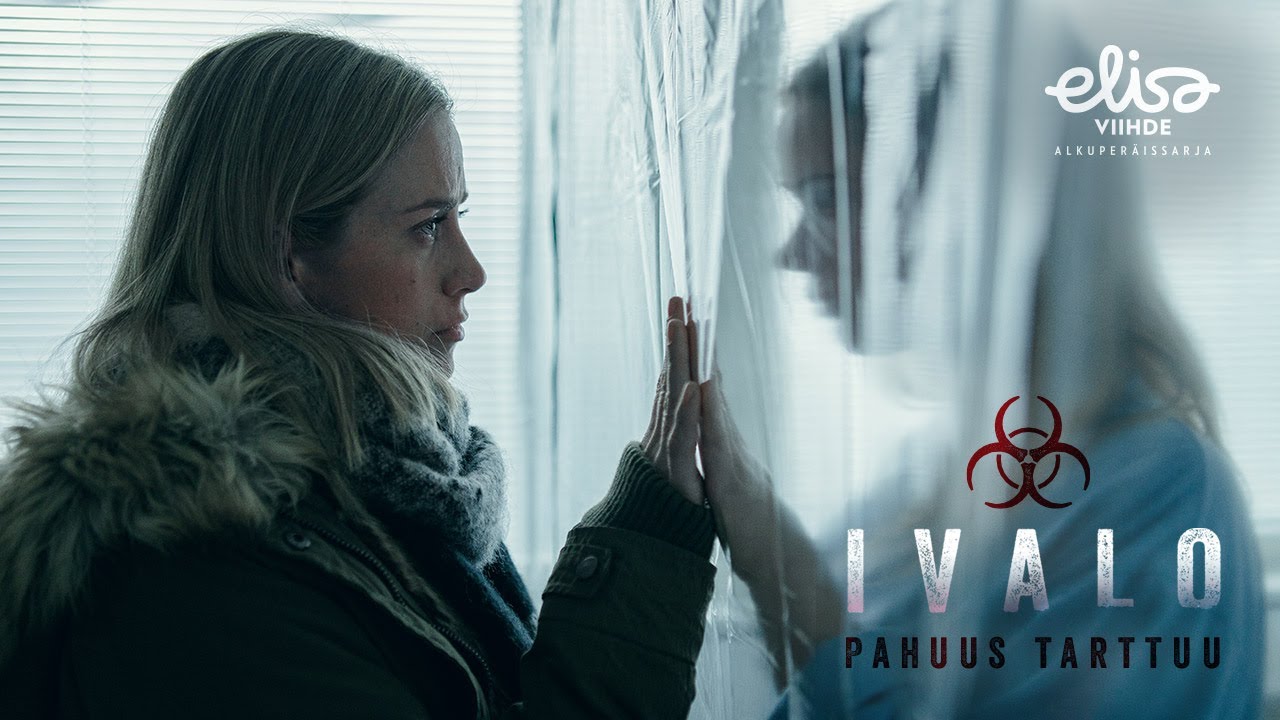
There are Nordic crime dramas that happen to be filmed somewhere cold.
And then there is Ivalo.
Known internationally as Arctic Circle, this Finnish crime drama takes us so far north that the landscape immediately changes the rules. Roads stretch through darkness and snow. Houses appear isolated from one another. Help feels far away. And suddenly the distance between two places becomes part of the story.
This isn’t Helsinki dressed for winter.
This is Finnish Lapland.
And you feel it.
A Crime Story That Could Only Happen Here
At the centre of the story is police officer Nina Kautsalo, played by Iina Kuustonen. In the first season, Nina discovers a critically ill woman held in a remote cabin. What initially appears to be a disturbing criminal investigation becomes something much larger when a dangerous virus is discovered in the woman’s blood and German virologist Thomas Lorenz becomes involved.
It is an unusual premise because Ivalo refuses to stay comfortably inside one genre.
It begins like Nordic noir.
Then crime, medicine, international interests and personal relationships start colliding.
But underneath everything remains the same question: what happens when something dangerous appears in a place that already feels cut off from the rest of the world?
That isolation makes everything more threatening.
In a city, there is always another street, another hospital, another police station, another person around the corner.
In Ivalo, sometimes there is simply snow.
The Landscape Isn’t Decoration
This is where the series becomes particularly interesting for me.
Lapland isn’t there simply because snow looks beautiful on television.
The landscape changes the rhythm of the investigation.
Distance matters.
Weather matters.
Darkness matters.
Getting from one place to another matters.
A cabin in the wilderness is genuinely isolated. A vehicle travelling along an empty road can seem incredibly vulnerable. Someone disappearing into this enormous landscape feels very different from someone disappearing in a city.
That is what the best location-led crime dramas understand.
Geography changes behaviour.
And Ivalo could not simply be relocated to another country without becoming a different programme.
On Location: Ivalo
The Finnish title comes directly from Ivalo, a village in the municipality of Inari in northern Finnish Lapland.
And this isn’t merely the fictional setting.
The production actually went there.
Director Hannu Salonen said Ivalo was deliberately chosen both as a filming location and as the Finnish title of the series, with much of the first season filmed in the area. The series has continued to use locations across Finnish Lapland, and other documented filming locations include Utsjoki and Helsinki.
There are even scenes filmed around the Saariselkä fell area: Finnish promotional material has shown Ivalo filming on Kaunispää fell, above Saariselkä in the municipality of Inari.
And that authenticity shows.
You cannot easily manufacture that sense of scale.
The characters often look tiny against their surroundings, which is precisely the point. Human dramas that seem enormous to the people experiencing them suddenly occupy a very small space inside an immense Arctic landscape.
Nina Kautsalo Belongs Here
Nina is also an important reason the series works.
She doesn’t feel like the kind of television detective who has been designed first and dropped into a location afterwards.
She belongs to this environment.
There is practicality about her. She gets on with things. There is no need to constantly remind us that she is a woman working in policing or turn her competence into some extraordinary characteristic.
She investigates.
She makes decisions.
She gets things wrong.
She has a life outside the investigation.
And once again we find something European crime drama has become very good at doing: allowing female investigators to simply occupy the centre of the story.
Not as a statement.
As a fact.
A Familiar Face from Freezing Embrace
There was also a small moment of excitement for me when I realised who was playing Esko.
For anyone who has watched Freezing Embrace, he is instantly recognisable as Antti Hautalehto — the detective at the centre of another Finnish crime drama I have already become very fond of. Seeing him suddenly appear in Ivalo felt like unexpectedly meeting someone you already know in another corner of Finland.
And I love when this happens.
The more European crime drama you watch, the more these connections begin to appear. An actor you first associate completely with one character suddenly turns up somewhere else, playing someone entirely different. It makes this enormous collection of dramas begin to feel strangely connected.
For me, Mikko Leppilampi was Hautalehto first.
So seeing Hautalehto standing there in Ivalo was impossible not to enjoy.
Finnish Noir Feels Different
The more Finnish crime drama I watch, the more I think it deserves to be separated slightly from the general Nordic-noir label.
Bordertown gave us the strange intelligence of Kari Sorjonen.
Freezing Embrace gave us another Finland of snow, small communities and crimes that slowly reveal what lies underneath everyday life.
And Ivalo takes us even further north.
There is something particularly Finnish about the restraint.
Characters do not need to constantly explain themselves. Conversations can be short. Silence is allowed to remain silence.
And the landscape fills the space left behind.
Perhaps that is why these dramas stay with me. They do not seem frightened of quietness.
But There Is Something Missing
There is one aspect of Ivalo that becomes difficult to ignore once you know where it was filmed.
Ivalo is in the municipality of Inari, within Finland’s Sámi homeland. Yet when the first series was being made, director Hannu Salonen openly explained that Sámi culture had deliberately not been incorporated into the story because the production wanted to concentrate on the individual characters rather than comment on contemporary Finnish society.
That decision is interesting.
Because if location matters — and in Ivalo it clearly does — then we also have to ask what it means to use the visual identity of a place while leaving part of its cultural identity outside the frame.
It doesn’t destroy the series.
But it is worth noticing.
Particularly for a drama that depends so heavily on the uniqueness of northern Finland.
Television That Looks Like Somewhere
This is exactly the kind of television I want to talk about on Mapped in Drama.
You could freeze almost any exterior frame of Ivalo and know immediately that you are not watching another anonymous crime series.
It looks like somewhere.
It sounds like somewhere.
The climate affects the characters. The geography affects the investigation. The distances affect the pace.
Even the snow isn’t just pretty.
It conceals things.
It isolates people.
It slows them down.
It makes darkness feel darker.
And when Ivalo sends Nina Kautsalo out into that enormous white landscape, the Arctic Circle stops being a backdrop.
It becomes part of the crime scene.
WATCH THE TRAILER BELOW